Vanuatu Money Guide: Vatu, ATMs, Cards and Tipping
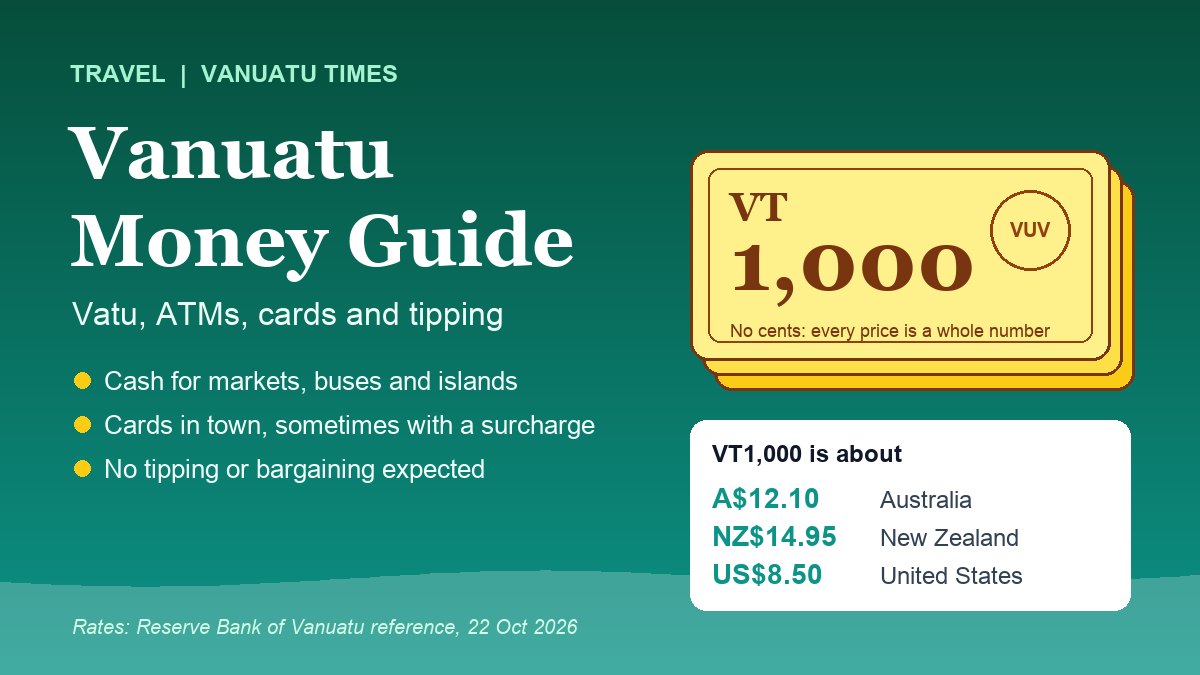
Short answer: Vanuatu uses the vatu (VT, currency code VUV), a currency with no cents. On 22 October 2026 the Reserve Bank of Vanuatu's reference rate put one Australian dollar at about VT82.6, one New Zealand dollar at VT66.9 and one US dollar at VT117.5, so VT1,000 is roughly A$12, NZ$15 or US$8.50. You can get vatu from ATMs and exchange counters at the Port Vila and Santo airports and in both towns. Cards work at hotels, resorts and bigger restaurants, sometimes with a surcharge, but markets, buses, taxis, village fees and the outer islands run on cash. You don't need to tip or bargain.
With a big Pacific fare sale running this week and Australians making up more than half of all air arrivals, a lot of first-time visitors are about to land in Port Vila holding money they can't spend at the market. This guide covers how the vatu works, the simplest ways to get it, when a card helps and when it doesn't, and the few prices you can plan around with confidence.
The vatu in one minute
The vatu was introduced in 1981, a year after independence, and is issued by the Reserve Bank of Vanuatu (RBV). Notes come in VT200, VT500, VT1,000, VT2,000, VT5,000 and VT10,000, and coins cover the small amounts. Because there are no cents, every price is a whole number and totals are simply rounded.
The RBV publishes a reference rate every business day. Here is what it looked like on 22 October 2026, with a quick conversion for a VT1,000 note:
- Australian dollar: VT82.57, so VT1,000 is about A$12.10
- New Zealand dollar: VT66.93, so VT1,000 is about NZ$14.95
- US dollar: VT117.47, so VT1,000 is about US$8.50
- Euro: VT131.94, so VT1,000 is about €7.60
- British pound: VT157.28, so VT1,000 is about £6.35
These are central bank reference rates. Banks and money changers buy and sell a little either side of them, so the rate you actually get will be slightly worse. For mental maths at the till, Australians can divide the vatu price by 100 and add a fifth (VT5,000 is about A$60), and New Zealanders can divide by 100 and add half (VT5,000 is about NZ$75).
How to get vatu
ATMs
The main banks in Port Vila and Luganville, including ANZ, BRED Bank, National Bank of Vanuatu and BSP, run ATMs, and there are machines at both international airports, so you can withdraw cash as soon as you land. Your own bank may charge an overseas withdrawal fee and the machine operator may add one too, so a few larger withdrawals usually cost less than many small ones. Check your card's daily limit before you fly.
Banks and exchange counters
The Vanuatu Tourism Office (VTO) says the most widely exchanged currencies are the Australian dollar, New Zealand dollar, US dollar and euro. Banks generally open on weekdays from about 8:30am to 3pm and close at weekends; most sit on Kumul Highway in Port Vila, with National Bank of Vanuatu on Rue de Paris. Private exchange offices fill the gap: the VTO lists No1 Currency at Port Vila airport as open daily from 4am to 11pm, plus counters in town and in Luganville. Rates vary between them, so it is worth comparing two before you change a large amount.
Before you fly to the outer islands
This is the mistake that catches people out. Tanna, Malekula, Pentecost and the smaller islands generally have no banks or exchange offices, and getting vatu once you are there can be difficult. Work out what you will need for the whole stay, including transfers, tours and village fees, and withdraw it in Port Vila or Luganville before your domestic flight. Our Tanna island guide explains what a typical visit to Mount Yasur involves.
Cards: where they work and what they cost
Visa and Mastercard are usually accepted at hotels, resorts, larger restaurants, supermarkets and many tour desks in Port Vila and Luganville. Smaller shops, market stalls, local tours and anything on the outer islands are often cash only. Travel guide My Vanuatu notes that some businesses add a card surcharge of around three to five per cent, so ask before you tap if you are paying for something expensive like accommodation or a dive package.
Two habits save money. First, if a card terminal offers to charge you in your home currency, choose vatu: the "convenience" conversion usually comes with a worse rate. Second, travel with at least one card that has low or no foreign transaction fees, and a backup card kept separately.
What about paying in Australian dollars? The VTO says they are sometimes accepted in tourist areas of Port Vila, with change given in vatu, but you should not rely on it. You will almost always get a better deal paying in the local currency.
Where you will need cash
- The municipal market in Port Vila, where produce, flowers and food stalls are priced in vatu. Our Port Vila city guide suggests going early.
- Buses and taxis. You pay the bus driver in cash, so keep small notes and coins.
- Kava bars. An evening at a nakamal is a cash affair; read our guide to kava culture before you go.
- Village and kastom fees for cultural sites, waterfalls, blue holes and custom villages. These fees support the landowners, which is part of how kastom works.
- Handicraft stalls and roadside fruit sellers.
- Anywhere outside Port Vila and Luganville.
The VTO's everyday advice is simple: carry vatu in small notes. A VT5,000 or VT10,000 note can be hard to break at a market stall or on a bus.
Prices you can plan around
Buses. Port Vila's minibuses have "B" number plates and no fixed routes; you flag one down and tell the driver where you're going. Under the Public Land Transport Authority's fare structure, in force since 1 September 2026, a trip within five kilometres of the former Post Office in central Port Vila costs VT150. That zone reaches as far as Breakas on Pango Road, Salili Store at Mele, Blacksands Bridge and Sunset Bungalows on Teouma Road. Each extra five-kilometre zone adds VT50, so a trip that crosses into the next zone costs VT200.
Taxis. Taxis are more expensive than buses and better for luggage or evenings, when fewer buses run. Agree the fare before you set off.
Tax. Vanuatu has no income tax, but VAT of 15 per cent applies to most goods and services. Vanuatu Customs and Inland Revenue confirms the rate rose from 12.5 per cent to 15 per cent in 2018. When you compare quotes for tours or accommodation, check whether VAT is included.
Tips. The VTO's official advice is that you don't need to tip or bargain. A sincere "tankyu tumas" (thank you very much) is the usual thanks. A small tip at a resort is fine but not expected, and tipping in village or kastom settings can feel out of place.
Is Port Vila expensive?
It depends on what you buy. Vanuatu imports most manufactured and packaged goods, so supermarket staples, alcohol and fuel often cost more than in Australia or New Zealand. Local produce from the market, bus rides and simple local meals are much cheaper. For most visitors the big costs are accommodation, domestic flights and tours, which are usually booked and paid by card, while day-to-day spending is small and mostly in cash.
If you want a visual sense of it, this traveller video compares prices on the ground:
When you go matters too. The drier months from May to October are the busiest, so book accommodation early if you are travelling then; our Port Vila weather by month guide explains the seasons, and our flights guide covers who flies in and when sales usually appear.
A simple cash plan for a one-week trip
- Pack a low-fee card, a backup card and a small amount of Australian or New Zealand dollars for emergencies.
- Withdraw vatu at the airport ATM or change a little at the arrivals counter so you can pay for your first bus or taxi.
- Ask for some VT200 and VT500 notes and keep them handy for buses, the market and kava.
- Plan bank errands for weekdays, because branches are closed at weekends.
- Before any outer-island trip, withdraw enough cash for the whole stay, then keep it split between two places.
- Ask about card surcharges before paying big bills, and always choose to be charged in vatu.
Quick answers
What currency does Port Vila use?
The Vanuatu vatu (VT or VUV), the same currency used across the country. There are no cents.
Can I use Australian dollars in Vanuatu?
Sometimes, in tourist parts of Port Vila, with change given in vatu. It is not reliable and the rate is rarely in your favour, so plan to pay in vatu.
Are there ATMs on Tanna and the other outer islands?
Don't count on finding one. The VTO advises getting the cash you need in Port Vila or Luganville before you travel on.
Sources
- Reserve Bank of Vanuatu: exchange rates (22 October 2026)
- Vanuatu Tourism Office: how to exchange money in Vanuatu
- Vanuatu Tourism Office: travel tips (currency, tipping)
- Vanuatu Tourism Office: how to catch the bus in Vanuatu
- Vanuatu Daily Post: Efate passengers face new bus fares (PLTA notice)
- Vanuatu Customs and Inland Revenue: Value Added Tax
- My Vanuatu: currency guide (card surcharges)
- Breaking Travel News: Qantas launches Pacific Islands sale (20 October 2026)
- Vanuatu Bureau of Statistics: international visitor arrivals, August 2026