How Safe Is Port Vila? Crime, Quakes and Health Risks
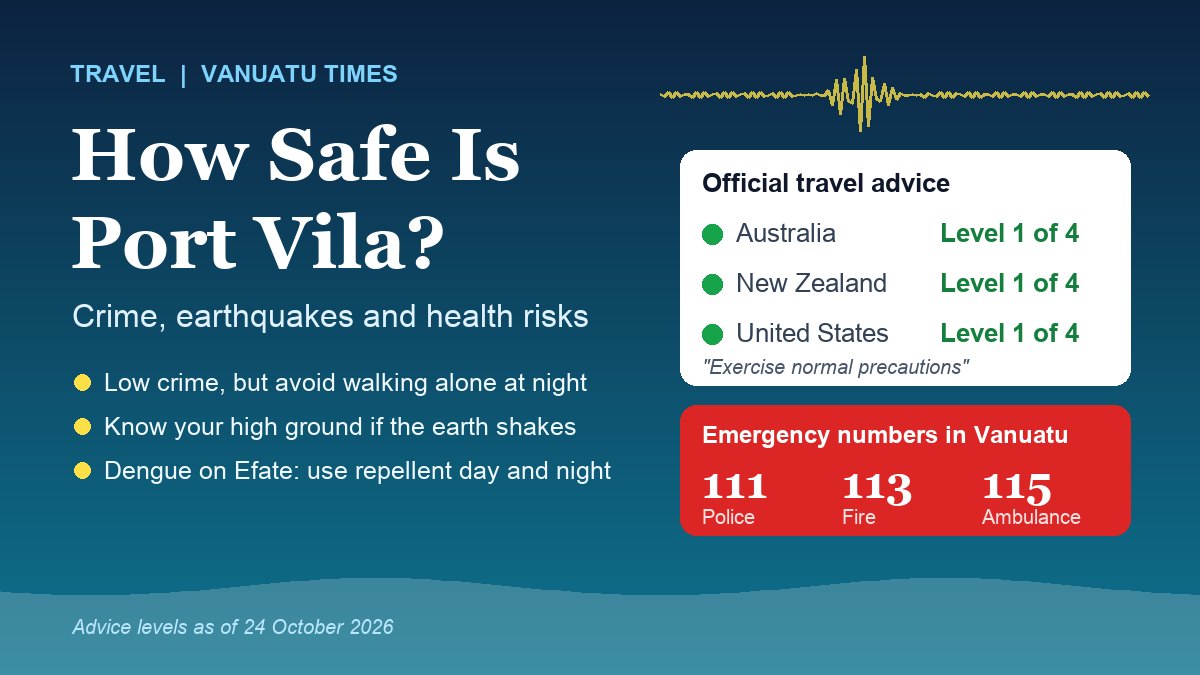
Short answer: Port Vila is a safe city for visitors by regional standards. Australia, New Zealand and the United States all rate Vanuatu at their lowest advice level ("exercise normal precautions"), and crime is low. The real risks are different from the ones most travellers worry about: petty theft and the occasional assault after dark, mosquito-borne illness such as dengue, limited hospital care, and natural hazards, because Vanuatu sits in one of the most active earthquake zones on Earth. Plan for those four things and you have covered almost everything.
That last point came into focus on Saturday 24 October 2026, when two strong earthquakes struck in the ocean off northern Vanuatu within minutes of each other and a tsunami warning was issued, then cancelled the same afternoon. With a big Pacific fare sale running and plenty of first-time visitors booking for the drier months, this guide sets out what is actually risky in and around Port Vila, what is not, and the handful of habits that make a trip smoother.
What the official travel advice says
Three governments publish regular advice for Vanuatu, and all three sit at level 1 of 4:
- Australia (Smartraveller): "Exercise normal safety precautions." The page was marked still current on 24 October 2026; its latest update concerns a dengue outbreak in south Efate.
- New Zealand (SafeTravel): "Exercise normal safety and security precautions" (level 1 of 4). It notes that tourism and accommodation operators in Port Vila are operating normally after the December 2024 earthquake.
- United States (State Department): Level 1, "Exercise normal precautions", describing Vanuatu as generally a safe destination for travellers.
Level 1 is the lowest rung on all three scales. It doesn't mean nothing can go wrong; it means the risks are the ordinary ones you manage with common sense.
Crime: low, but not zero
Smartraveller describes crime in Vanuatu as low. New Zealand's advice adds the useful detail: robberies, assaults and sexual assaults against foreigners do happen, including in homes and on public transport, mostly in Port Vila, and the risk rises after dark, in isolated places and when you are alone. Smartraveller also notes that crime tends to rise in the lead-up to holidays such as Independence Day on 30 July and Christmas.
In practice, that translates into a short list of habits:
- Don't walk alone at night. Use a bus or taxi after dark, even for short distances along the waterfront.
- Lock up. Close and lock doors and windows in self-contained rentals and bungalows at night and when you go out, and use the room safe for passports and cash.
- Keep beach bags light. Don't leave phones and wallets unattended on the sand while you swim.
- Use licensed transport. Port Vila's minibuses and taxis are the normal way to get around; ask your accommodation which operators they use if you are unsure.
Most visitors never encounter any trouble at all. Our Port Vila city guide covers the neighbourhoods, market and waterfront if you want to know the layout before you arrive.
Earthquakes and tsunamis: what the 24 October quakes showed
Vanuatu lies on the Pacific "Ring of Fire", where the Australian plate dives beneath the Pacific plate. Small tremors are an everyday event and most are barely noticed. Larger ones are a real, if infrequent, hazard.
On 24 October 2026, the US Geological Survey recorded a magnitude 6.9 earthquake about 200 kilometres west of Sola in the far north of the country, at a shallow depth of about 10 kilometres, early in the afternoon local time. The Pacific Tsunami Warning Center initially listed it at 7.2. A second quake of about magnitude 6.3 followed within minutes. The warning centre said hazardous waves were possible on coastlines within 300 kilometres of the epicentre. Later that afternoon the Vanuatu Geological Hazards Department said that, based on the latest sea level and observation data, there was no longer a tsunami threat to Vanuatu's coasts, and the warning was cancelled. Strong quakes continued off the northern islands overnight, and a separate magnitude 6.3 quake had struck off Vanuatu on 20 October without any tsunami threat.
The epicentres were hundreds of kilometres north of Efate, so Port Vila itself was not the focus. The city does know what a close quake feels like, though: a magnitude 7-plus earthquake near Port Vila on 17 December 2024 damaged buildings and roads, especially in the central business district. Some buildings have since been demolished and others repaired, and both Australia and New Zealand say the city is open for business, although reconstruction work continues in places.
What to do if the ground shakes
- During shaking: drop, take cover under something sturdy and hold on. Stay away from windows and anything that can fall.
- Near the coast: if a quake is long or strong (Smartraveller's rule of thumb is more than a minute, or hard to stand up), don't wait for a siren. Walk to high ground or well inland straight away. A tsunami can arrive within minutes of a nearby quake.
- Afterwards: follow local authorities and your hotel's instructions. The Vanuatu Meteorology and Geo-Hazards Department (VMGD) and the National Disaster Management Office (NDMO) publish warnings and all-clears.
It takes two minutes on arrival to ask reception where the nearest high ground is and how the hotel handles warnings. That is the single most useful safety question you can ask in Port Vila.
Cyclones and volcanoes
The cyclone season runs from November to April, although storms occasionally form outside it. Cyclones come with days of warning, and Vanuatu's NDMO uses a colour-coded alert system with instructions for each stage. If one approaches, flights can be suspended and seats on the remaining services fill quickly, so travel insurance that covers disruption is worth having. Our Port Vila weather by month guide explains when the wet and cyclone seasons are most active, and our piece on the recovery from Cyclone Harold shows what a severe storm can do.
Vanuatu also has several active volcanoes, including Mount Yasur on Tanna, one of the most visited volcanoes in the world. VMGD sets an alert level for each one, and tour operators follow exclusion zones when activity rises. Check the current level before you book a volcano trip and follow your guide's instructions at the crater rim. Our Tanna island guide explains how a typical Yasur visit works.
Health: the risk most visitors underestimate
For most travellers, a mosquito bite or a bad infection is far more likely than any crime or natural disaster.
- Dengue: an outbreak was declared in June 2026 in the south of Efate, the island Port Vila is on. Use repellent during the day as well as at night, and wear loose, light-coloured clothing.
- Malaria: present mainly in the northern provinces of Sanma, Penama and Torba. If you are heading to Santo, Pentecost, Ambae or the Banks and Torres islands, ask your doctor about antimalarial medication before you leave.
- Vaccinations: make sure routine shots are up to date. Smartraveller notes pertussis (whooping cough) outbreaks on several islands, and New Zealand's advice suggests discussing tetanus, hepatitis A and typhoid with your doctor.
- Water: tap water in Port Vila and Luganville is generally considered safe, but it can be affected after cyclones or heavy rain. Bottled or boiled water is the cautious choice, and the only sensible one on outer islands.
- Medical care: facilities are limited, and serious cases may need evacuation to Australia or New Zealand, which is expensive and hard to organise. Make sure your insurance covers medical evacuation. Our explainer on Vanuatu's health system gives the background.
In the water and on the road
The lagoons are a big part of Port Vila's appeal and are generally calm, but treat open-water swimming with the same care you would at home. Smartraveller notes a handful of shark sightings and minor attacks around Port Vila in mid-2024, so follow local advice and swim where others do. Coral cuts infect easily in the tropics, so clean and cover any graze the same day. If you plan to dive, use an established operator; our guide to diving in Vanuatu covers the main sites.
On the road, expect potholes, unlit stretches and the odd wandering animal outside town. If you rent a car or scooter, avoid driving at night, and never drive after an evening at a nakamal: kava is stronger than many visitors expect. Our guide to kava culture explains the etiquette.
Between islands, New Zealand's advice is cautious about local boats and ferries, which can be unreliable and do not all carry current seaworthiness certificates. It also notes serious incidents involving domestic charter flights. Scheduled domestic flights and established tour operators are the safer choice.
Local laws and customs worth knowing
- Dress modestly away from the beach and pool. Vanuatu is a predominantly Christian country, and swimwear in town or in villages can cause offence.
- Weekend alcohol rules: supermarkets cannot sell alcohol from midday Saturday until 7am Monday, although hotels, bars and clubs still serve it.
- Drugs: penalties are severe, and the US government warns that bringing cannabis or CBD products into Vanuatu is illegal even with a prescription.
- Same-sex couples: same-sex relationships are legal but not widely accepted, particularly outside Port Vila, and official advice suggests avoiding public displays of affection.
- Ask before you photograph people, villages and kastom sites, and pay the small landowner fees for waterfalls and cultural sites. Our kastom explainer covers why these matter.
Emergency numbers to save before you land
- Police: 111 or 22222
- Fire and rescue: 113
- Ambulance: 115 (the Pro-Medical service, Port Vila and Luganville only)
- Your high commission or embassy in Port Vila for consular help. Registering your trip with your government's travel service means alerts like the 24 October tsunami warning reach you directly.
Quick answers
Is Port Vila safe at night?
Restaurants, bars and the waterfront are busy and generally fine in the evening, but walking alone after dark is when most incidents happen. Take a bus or taxi back to your accommodation.
Is Port Vila safe for solo female travellers?
Many women travel solo in Vanuatu without problems. Follow the same rules: avoid walking alone at night or in isolated spots, use transport your accommodation recommends, and dress modestly in town.
Should I cancel my trip because of the recent earthquakes?
None of the three governments raised its advice level after the 24 October quakes, and the tsunami warning was cancelled the same day. Keep an eye on VMGD and your airline, know where high ground is from your accommodation, and carry insurance that covers disruption.
When is the best time to visit for weather?
May to October, outside the cyclone season. It is also the busiest period, so book flights and rooms early; our flights guide and money guide cover the practical side.
Sources
- Smartraveller (Australian Government): Vanuatu travel advice, still current at 24 October 2026
- SafeTravel (New Zealand Government): Vanuatu travel advice
- US Department of State: Vanuatu country information and travel advisory
- RNZ: Tsunami warning cancelled after magnitude 7.2 quake off Vanuatu (24 October 2026)
- ABC News: Two large earthquakes off coast of Vanuatu prompt tsunami warning (24 October 2026)
- Vanuatu Meteorology and Geo-Hazards Department (VMGD)
- Vanuatu National Disaster Management Office (NDMO)