Espiritu Santo, Vanuatu: Best Things to Do on the Biggest Island
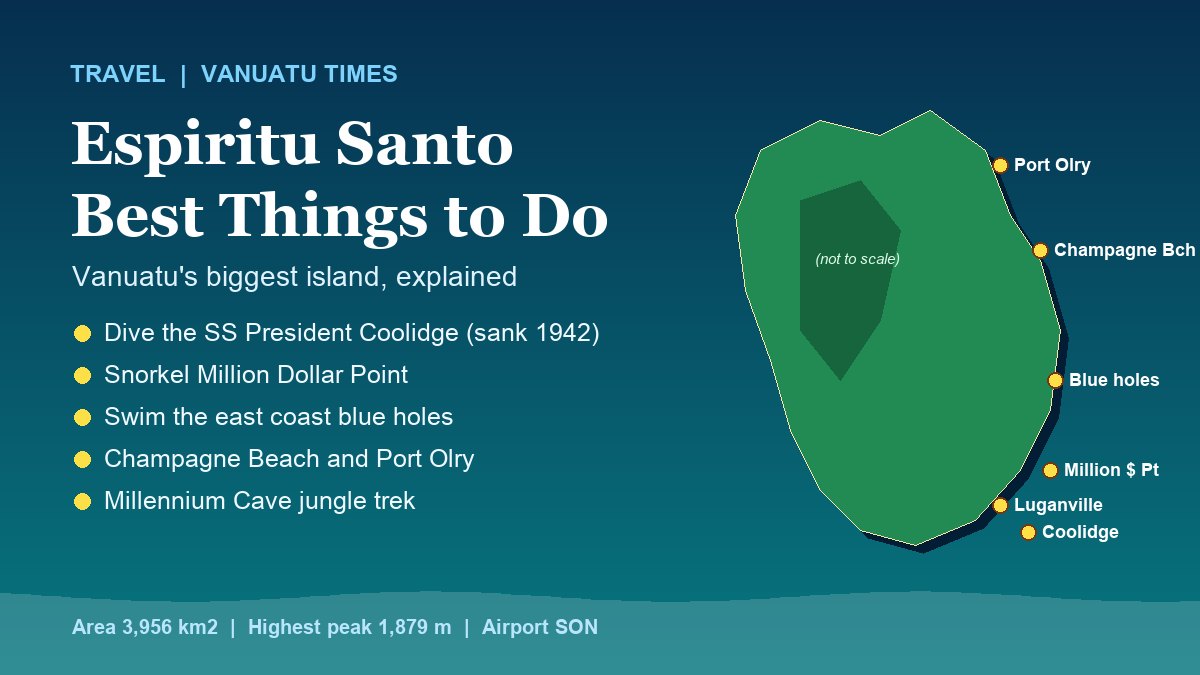
Short answer: Espiritu Santo, usually just called Santo, is Vanuatu's largest island and the country's best base for wreck diving, white-sand beaches and freshwater blue holes. Most visitors stay in or near Luganville, the only real town, dive the SS President Coolidge, then drive the sealed east coast road north to the blue holes, Champagne Beach and Port Olry. Give it at least four nights, carry vatu cash for the custom-land fees, and plan around the November to April wet season.
Santo is in the news this week for a less welcome reason: a sequence of strong earthquakes off the north of the island, starting with magnitude 6.9 and 6.3 shocks on 24 October 2026 and a magnitude 6.1 quake about 25 km from Port Olry the next day. The tsunami warning was lifted the same day, and it is a good moment to understand the island properly before you book. Monday 26 October was also the 84th anniversary of the Coolidge sinking, the event that made Santo one of the world's best-known dive destinations.
Santo at a glance
- Size: about 3,956 square kilometres, the largest island in Vanuatu, although Efate (home of Port Vila) has more people.
- People: 37,328 at the 2020 census. Luganville, the second-largest town in the country, had 17,719.
- Highest point: Mount Tabwemasana, 1,879 metres, the highest peak in Vanuatu.
- Airport: Santo-Pekoa (SON), just east of Luganville.
- Province: Sanma. Locals on the northern islands often call Luganville itself "Santo", and rural people call it "Kanal", after the old French name for the Segond Channel.
Getting to Espiritu Santo
Most people fly into Port Vila and take a domestic Air Vanuatu flight north, which takes about an hour. Santo also has its own international link: Solomon Airlines flies Brisbane to Santo non-stop, which saves a day if Santo is your main stop. Our guide to flights to Vanuatu lists who flies where and how the routes changed after Air Vanuatu cut its international network.
Once you land, taxis meet flights and the drive into Luganville takes around 15 minutes. If you want to see the east coast at your own pace, hire a car in town; otherwise most resorts and tour operators include transfers. The main road from Luganville to Port Olry is sealed, while roads to the west and into the interior are rough and often need a 4WD and a local guide.
Best things to do on Santo
1. Dive (or snorkel above) the SS President Coolidge
The President Coolidge was an American luxury liner turned troopship. On 26 October 1942 it entered the harbour at Luganville without being warned about a protective minefield, struck two US mines and was run aground. Almost everyone of the roughly 5,000 men on board walked ashore; two died, fireman Robert Reid and Captain Elwood Euart, who went back inside to rescue trapped men. The ship slid down the slope and now lies close to the shore, starting at around 20 metres. Since 1983 no salvage or souvenir hunting has been allowed.
Because you walk in from the beach, the Coolidge is easier to reach than most big wrecks. Beginners can see the bow, cargo holds and military gear on shallow guided dives, while experienced divers spend several dives inside to reach "The Lady", a porcelain relief of a woman riding a unicorn, deep inside the ship. Book with a Luganville dive shop, follow your guide's depth limits and leave the standard no-fly gap (at least 18 hours after several days of diving) before your flight home. Our Vanuatu diving overview compares Santo with the sites around Efate and Tanna.
2. Million Dollar Point
At the end of the Second World War the United States ran one of its largest Pacific bases on Santo. When it left in 1946, shipping the surplus home was judged too expensive, and the equipment was driven off a ramp into the sea. Bulldozers, trucks, jeeps and crates still lie a short swim from the beach, a few kilometres east of town. It is an easy and atmospheric snorkel on a calm day; there is usually a small entry fee at the access point.
3. The blue holes
Santo's limestone east coast is full of springs that well up into clear, intensely blue pools. The best known, including Matevulu, Riri and Nanda, are all within reach of the east coast road between Luganville and Port Olry. Some have rope swings and jetties, and at least one is usually visited by canoe or kayak along a small river. They are fresh water, cool and calm, which makes them a good choice for families and non-divers.
4. Champagne Beach and Port Olry
Champagne Beach, near the village of Hog Harbour on the north-east coast, is the island's postcard view: fine white sand, shallow clear water and a curve of bay that cruise ships now visit regularly. Check whether a ship is in before you go, because the beach is far quieter on non-cruise days. A little further north, Port Olry has its own long sandy bay, small guesthouses and simple seafood places, and is the place to stay if you want an evening by the sea rather than in town.
5. Millennium Cave and the interior
The most popular adventure day on Santo is the guided Millennium Cave trek: a walk through village gardens and rainforest, a passage through a cave with a stream running through it, and a float or scramble down a river canyon. It is wet, slippery and long, so you need decent fitness, water shoes and a waterproof bag. The trek crosses customary land and always runs with local guides, booked through operators in Luganville.
Serious hikers can attempt Mount Tabwemasana on the west side, but it is an expedition rather than a day trip. The usual approach is by boat from Tasiriki to Kerepua, then up a river valley and a steep climb; guides are required because the track is hard to follow.
6. Big Bay and the island's history
Big Bay on the north coast is where Europe first arrived: Pedro Fernandes de Queiros anchored there in 1606 and named the land "Austrialia del Espiritu Santo", believing he had found the great southern continent. Today it is a remote, quiet area best visited with a guide. Back in Luganville, the town grew up around the wartime base, and its market, waterfront and scattered war relics are worth an afternoon.
How long to stay and where to base yourself
- 3 nights: one Coolidge dive or Million Dollar Point snorkel, one east coast day (blue holes and Champagne Beach), one day for the market and town.
- 5 nights: add Millennium Cave and a night at Port Olry or a resort on the east coast.
- A week or more: several Coolidge dives, Big Bay or a village stay, and slower beach days.
Luganville suits divers and anyone without a car, because the dive shops, banks, supermarkets and market are there. The east coast resorts and bungalows suit couples and families who want the beach on the doorstep. Remote areas mean simple island bungalows, often with limited power and cash-only payment.
Money, kastom and practical tips
- Cash matters: Luganville has ATMs and card machines, but outside town you pay in vatu cash. Most beaches, caves and blue holes are on customary land and charge a small entry fee. Our Vanuatu money guide explains the vatu, ATMs and card surcharges.
- Ask first: land belongs to families and villages, not the state. Ask before entering gardens, taking photos of people or using a beach in front of a village. Our explainer on kastom in Vanuatu covers why this matters.
- Kava: Luganville has nakamals where you can try kava in the evening; read our kava culture guide first so you know the etiquette.
- Language: Bislama is the everyday language, with English and French widely understood in town. A few words from our Bislama guide go a long way.
- Health: use insect repellent (dengue and malaria are present in parts of Vanuatu), drink bottled or treated water in rural areas and bring a basic first-aid kit; serious medical cases are usually evacuated to Port Vila or overseas.
When to go, and what the October quakes mean
Santo is hot and humid all year. The drier, cooler months are May to October; November to April is the wet and cyclone season, when rough roads and some tours can be disrupted. See our month-by-month weather guide for rainfall and cyclone timing.
Earthquakes are a normal part of life in Vanuatu. In the 24 and 25 October 2026 sequence, the two largest shocks were centred in the ocean more than 150 km north-west of Santo, and the magnitude 6.1 quake on 25 October was about 25 km off Port Olry. US Geological Survey records show further moderate quakes since, including a magnitude 5.8 on 27 October. For travellers, the advice is the same as anywhere in the country: if you are on the coast and feel strong or long shaking, move to high ground straight away without waiting for an official warning, and follow the Vanuatu Meteorology and Geo-Hazards Department (VMGD) for alerts. Our Vanuatu safety guide covers what to do during a quake and how to read the official travel advice.
Santo or Tanna?
If you only have time for one outer island, choose by what you want to see. Santo is about water: wreck diving, snorkelling, blue holes and beaches, with easy logistics from Luganville. Tanna is about Mount Yasur, the active volcano, and traditional village life, with simpler facilities. Our Tanna island guide covers the volcano trip, and our Port Vila city guide helps with the nights you spend on Efate either side.
Frequently asked questions
Is Espiritu Santo worth visiting?
Yes, especially for divers, snorkellers and anyone who wants quieter beaches than Efate. The Coolidge wreck, Champagne Beach and the blue holes are all within a day's drive of Luganville.
Can you visit Santo without diving?
Easily. Million Dollar Point, the blue holes and Champagne Beach are snorkel or swim trips, and Millennium Cave is a hiking day.
Is it safe to go to Santo after the October 2026 earthquakes?
The quakes were offshore and the tsunami warning was lifted the same day. Check the latest Smartraveller or SafeTravel advice and VMGD bulletins before you travel, and know the "strong shaking, go to high ground" rule.
Sources
- US Geological Survey: M 6.9, 197 km WNW of Port-Olry, Vanuatu (24 October 2026)
- US Geological Survey: M 6.1, 25 km ENE of Port-Olry, Vanuatu (25 October 2026)
- Vanuatu Meteorology and Geo-Hazards Department (VMGD)
- Smartraveller (Australian Government): Vanuatu travel advice
- SS President Coolidge: history, sinking and 1983 protection
- Naval Advance Base Espiritu Santo and Million Dollar Point
- Luganville: 2020 census population and airport
- Mount Tabwemasana: height and access route