Economy
How Vanuatu's Economy Works: Tourism, Farming and Citizenship Revenue
Vanuatu's economy is small and growing again after the 2024 earthquake. Here is how tourism, farming and citizenship receipts fit together, with the latest World Bank and ADB figures.
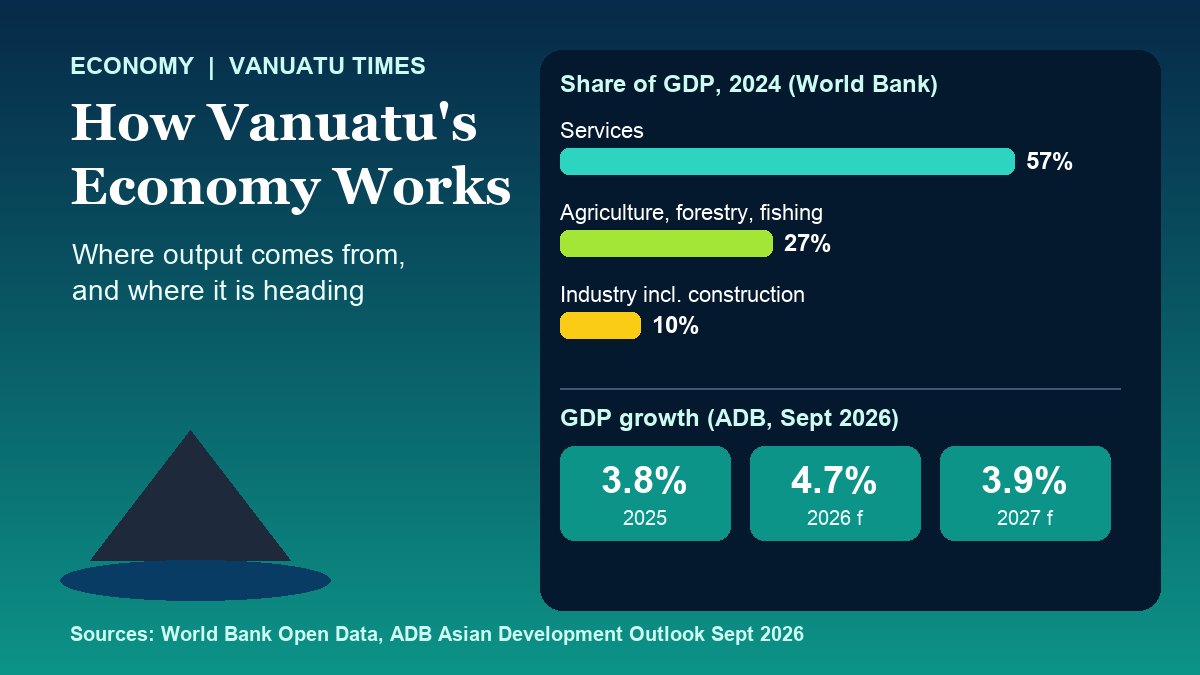
Short answer: Vanuatu's economy runs on three legs: services led by tourism, farming that still employs close to half of all workers, and government income that now includes a fast-growing slice of citizenship receipts. It is small, about US$1.35 billion in 2025 on World Bank data, and growing again after the December 2024 earthquake. The Asian Development Bank's September 2026 outlook expects GDP growth of 4.7% in 2026 and 3.9% in 2027. The same outlook lists El Niño, higher fuel prices and natural hazards as the main risks.
This guide explains how those pieces fit together, with the latest published numbers and where each one comes from. It is a plain-English explainer for readers, diaspora and travellers, not investment advice.
The economy in numbers
Here are the headline figures from the World Bank's public data and the ADB's September 2026 Asian Development Outlook:
- Size: GDP of about US$1.35 billion in 2025 (current US dollars), or roughly US$4,039 per person, for a population of about 335,000.
- Structure (2024): services about 57% of GDP, agriculture, forestry and fishing about 27%, and industry including construction about 10%.
- Jobs: an ILO modelled estimate puts about 44.5% of employment in agriculture in 2025, far above agriculture's share of output. That gap is why farming matters so much for household incomes even though services produce more of the GDP.
- Growth (ADB): 3.8% in 2025, a forecast 4.7% in 2026 and 3.9% in 2027.
- Inflation (ADB): 0.7% in 2025, forecast 2.0% in 2026 and 2.7% in 2027.
- Public debt: 36.6% of GDP at the end of June 2026, with external debt, mostly concessional, at 25.3% of GDP (ADB).
A caution on reading these: shares of GDP do not add to exactly 100% because the World Bank series leaves out taxes less subsidies, and the latest year for each indicator differs. Treat them as a snapshot, not a single-year accounting.
Leg one: tourism and services
Services are the largest part of the economy, and tourism is the biggest export. The World Bank's tourism series puts international tourism receipts at about US$295 million in 2019, equal to roughly 91% of exports of goods and services. In 2020, when borders closed, receipts fell to US$67 million. That one chart explains why Vanuatu felt the pandemic so hard, and why our piece on tourism after COVID asks what kind of visitor the islands want.
The recovery is now visible. The ADB reports that visitor arrivals rose 60% year on year in the first quarter of 2026, with air arrivals up 34% and cruise arrivals up 69%, led by Australia on the air side. It credits restored port infrastructure for part of the cruise rebound. If you are planning a trip, see our guide to who flies to Port Vila and Santo, since air capacity is part of what limits growth.
Leg two: farming, copra, kava and the outer islands
Most of Vanuatu's farming is small-scale. Families grow food crops for themselves and sell cash crops when prices allow. The best-known cash crops are copra, dried coconut meat sold to oil processors, and kava. The ADB's September 2026 outlook says agriculture remained resilient, with higher copra and kava exports in the first quarter of 2026, and cites export earnings up 80.2% over January to April 2026 compared with the same months of 2025.
Export earnings can swing sharply from year to year, and farm income is volatile. Copra prices follow the global vegetable oil market, which we explain in our copra and coconut piece, and kava sits at the centre of a culture as well as a market. For the food side, see Vanuatu's agriculture and food security. The ADB flags El Niño conditions as a particular risk to production.
Leg three: government finances, VAT and citizenship receipts
Government income comes from taxes such as VAT, grants from development partners, and citizenship programme receipts. The ADB's latest outlook says the government ran a fiscal surplus of 3.3% of GDP in the first half of 2026. Revenue dipped slightly from a year earlier because lower grants outweighed higher VAT and citizenship receipts. Spending moved toward capital projects: government and donor-financed capital investment was up 61.5% year on year in the first half, as repairs and reconstruction continued.
The citizenship programme is the part readers ask about most. The ADB confirms that citizenship receipts are rising and that they help the budget; this guide does not use any unverified percentage for how much. If you want the official fee table and who can apply, read our guide to Vanuatu citizenship costs, and see where the passport is accepted in our visa-free countries guide, because visa access affects how long the programme stays attractive.
What changed after the December 2024 earthquake
The ADB describes the economy as still recovering from the December 2024 earthquake. Growth in 2025 and 2026 has been helped by reconstruction, public investment and tourism. Its outlook says growth should ease to 3.9% in 2027 as the boost from rebuilding fades. Other signs of activity it lists include private lending up 12.4% over the year to May 2026, job vacancies more than doubling year on year in May 2026, and record cement imports in the first quarter.
The earthquake is one shock in a long list. Cyclones, volcanic activity and drought are recurring risks for output and public finances. Our Cyclone Harold reconstruction story shows how recovery plays out on the ground.
The risks to watch
- Fuel prices. The ADB says higher fuel prices linked to the Middle East conflict are pushing inflation up from a very low base, and that Vanuatu has used social transfers and subsidies to contain the impact.
- El Niño and weather. Dry conditions can cut crop output, and cyclone season brings its own risk. Our Port Vila weather guide explains the seasons.
- Fading reconstruction boost. As rebuilding slows, growth has to come from tourism and exports.
- Aid and grants. Lower grants were already visible in first-half revenue.
- Dependence on a few sectors. A narrow base is the same problem that made 2020 so painful.
What it means for travellers and readers
- Prices: inflation is low by global standards, but fuel and imports flow into transport and food costs. Budget with some margin, and see our guide to vatu, ATMs and cards.
- Capacity: more visitors means tighter flights and rooms in peak months, so book early.
- Diaspora and investors: check any figure against the original sources below. Fees, rules and forecasts change, and nothing here is financial or legal advice.
Frequently asked questions
What is the main industry in Vanuatu?
Services, led by tourism. The World Bank's data shows services at about 57% of GDP in 2024. Agriculture is smaller by output but employs a very large share of workers.
How big is Vanuatu's economy?
About US$1.35 billion in 2025 in current US dollars on World Bank data, or roughly US$4,000 per person.
Is Vanuatu's economy growing?
Yes. The ADB's September 2026 outlook forecasts 4.7% growth in 2026 and 3.9% in 2027, after 3.8% in 2025.
Does Vanuatu earn money from selling citizenship?
Yes. The ADB lists higher citizenship receipts alongside higher VAT in first-half 2026 revenue. Read our guide on fees and eligibility for the official detail.
What are the main risks to the economy?
The ADB names higher global fuel prices, weaker global growth, exposure to natural hazards and El Niño conditions that could reduce farm output.
Sources
- Asian Development Bank: Vanuatu economy and forecasts
- Asian Development Outlook, September 2026 and its Pacific chapter (PDF), Vanuatu section
- World Bank Open Data: Vanuatu (GDP, GDP per person, population, sector shares, employment and tourism receipts series)
- Vanuatu National Statistics Office
- Reserve Bank of Vanuatu
Figures were read from the sources above on 2 November 2026 and may be revised. This guide is general information, not financial, investment or legal advice.