Environment
Vanuatu Volcano Alert Levels: What Each Active Volcano's Status Means
Vanuatu rates each volcano from Level 0 to 5. Here is what the levels mean and where Ambrym, Ambae, Yasur, Lopevi, Gaua, East Epi and Vanua Lava stand on the VMGD list, with how to check before you travel.
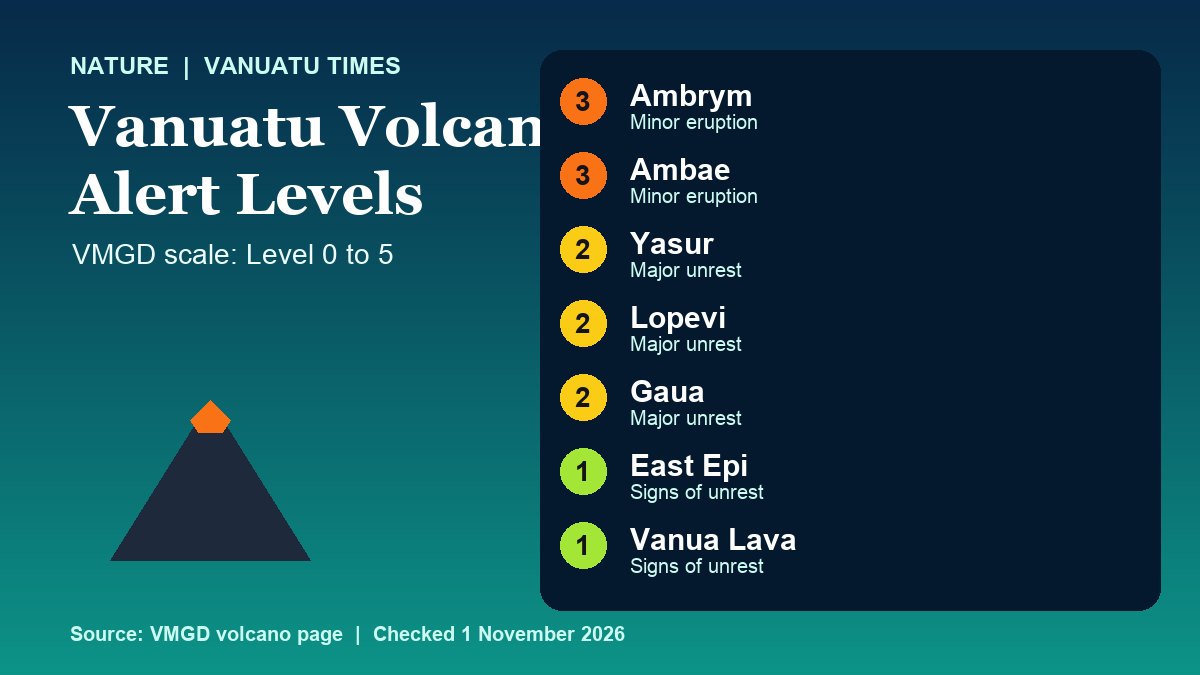
Short answer: Vanuatu uses a six-step volcanic alert scale, from Level 0 to Level 5, set for each volcano by the Vanuatu Meteorology and Geo-hazards Department (VMGD). On the VMGD volcano page checked on 1 November 2026, seven volcanoes had a status above normal: Ambrym and Ambae at Level 3 (minor eruption), Yasur, Lopevi and Gaua at Level 2 (major unrest), and East Epi and Vanua Lava at Level 1 (signs of unrest). The level tells you what the volcano is doing. It does not tell you whether you can visit, so check the danger zone and local advice as well.
This guide explains what the numbers mean, what is behind each of the seven volcanoes on the list, and where to look before you plan a trip to an outer island. It is general information based on VMGD's own pages. Levels can change at any time, so always check the live page.
What the alert levels are
VMGD says that Vanuatu uses a system of Volcanic Alert Levels to define the current status of each volcano, with levels from 0 to 5, and that the levels are used to guide an appropriate response. On the pages we read, three labels are in use:
- Level 1: signs of volcanic unrest. The volcano is showing changes that are being watched closely.
- Level 2: major unrest. The volcano is active at a level that carries a defined danger zone around the vents.
- Level 3: minor eruption. Eruptive activity such as ash, explosions or lava is happening, usually close to the crater.
Levels 4 and 5 sit above these, and Level 0 is the baseline. No volcano on the VMGD list was at those levels on 1 November 2026, so we do not describe them here.
One thing to watch for: older references can describe a smaller scale. The Smithsonian's Global Volcanism Program, for example, quoted Yasur at Level 2 "on a scale of 0-4" in a 2021 report. Use VMGD's current 0 to 5 wording.
The current picture, volcano by volcano
VMGD lists the most active volcanoes first. Here is the list as shown on 1 November 2026, with the type of volcano and the island:
- Ambrym (Benbow and Marum), Level 3, minor eruption.
- Ambae (Manaro Voui), Level 3, minor eruption.
- Yasur, Tanna, Level 2, major unrest.
- Lopevi, Level 2, major unrest.
- Mount Garet, Gaua, Level 2, major unrest.
- East Epi (submarine), Level 1, signs of unrest.
- Suretamatai, Vanua Lava, Level 1, signs of unrest.
Ambrym: Level 3, almost annual eruptions
Ambrym is a broad basaltic shield volcano with a caldera about 12 kilometres wide, and VMGD calls it one of the most active volcanoes in the Vanuatu arc. The Benbow and Marum cones inside the caldera used to hold glowing lava lakes that were visible at night. After the mid-December 2018 eruption those lava lakes disappeared, and the night-time glow that residents and visitors once saw is no longer visible. VMGD says Ambrym is still highly active, with eruptions almost every year from cones inside the caldera or from vents along the flanks. The most recent event listed on its page is a lava flow in Benbow crater on 13 to 16 January 2024, with loud explosions, gas and a glow.
Ambae: Level 3, still degassing after 2017 to 2018
Ambae, or Manaro Voui, is the biggest volcano by volume in the Vanuatu arc, a shield volcano with two nested calderas and three crater lakes. Its 2017 to 2018 eruption (6 September 2017 to 21 September 2018) is described by VMGD as the largest and most damaging in recent history. Thick ash fall hit food and water supplies, shelter and health on the island and caused serious humanitarian problems. Today the active crater is releasing steam and sulphur dioxide continuously.
Yasur: Level 2, the volcano people visit
Yasur is a 361-metre scoria cone at the south-east tip of Tanna with a crater about 400 metres wide. VMGD says it has been in more or less continuous activity since Captain Cook saw ash eruptions in 1774, and that it is the most visited volcano in Vanuatu. Level 2 is its normal state, which is why tours run. For how a visit works and what Level 2 means at the rim, see our guide to visiting Mount Yasur safely and our Tanna island guide.
Lopevi: Level 2, a small cone with a loud history
Lopevi is a small conical volcano about 7 kilometres wide, rising to 1,413 metres, with activity at both the summit and fissures along a north-west to south-east line across the island. VMGD's page lists a short steam and gas column on 12 to 13 January 2017 and a Plinian eruption with lava flows on 8 June 2003, so a quiet record does not mean a quiet volcano.
Mount Garet on Gaua: Level 2
Mount Garet sits inside a 6 by 9 kilometre caldera on Gaua, surrounded by crescent-shaped Lake Letas. The latest eruption listed by VMGD is 3 May 2022, when locals at Naveto village in the north-east of the island reported loud explosions and a thick ash column above the summit. It had earlier produced ash and explosions between November 2009 and December 2010.
East Epi: a submarine volcano at Level 1
East Epi is a cluster of underwater cones off the east coast of Epi island. The 2023 activity was at the Epi B cone: phreatic explosions threw ash about 100 metres into the air for a few hours on 1 February 2023. VMGD's Bulletin No. 18 of 2026 says the alert level has been 1 since 1 February 2023, that seismic data still show unrest, and that the danger zone is a 2 kilometre radius around the active vents. Boat owners and ship captains are told not to enter it and to expect floating pumice, which can wash up on nearby coasts.
Suretamatai on Vanua Lava: Level 1
Suretamatai is a chain of small stratovolcanoes with no summit caldera. Its main sign of life is a geothermal area with slightly superheated fumaroles, hot springs and boiling ponds. VMGD's page lists activity in 1937, 1991 and from 2009 to date, mostly in that geothermal area, plus an ash plume in 1965 and a small phreatic eruption in 1966.
Why the number is not enough by itself
Each level comes with a danger zone, and the size of that zone depends on the volcano. At Yasur, VMGD describes Level 2 as major unrest with a danger zone of 600 metres around the eruptive vents, and warns that eruptions can happen with little or no warning. At East Epi, Level 1 comes with a 2 kilometre zone around the submarine vents. So a lower number does not always mean a smaller exclusion area. The key points:
- Read the bulletin, not only the number. It explains the danger zone and who it applies to.
- The VMGD volcano pages also carry long-term hazard maps for the islands, volcano survival guides in English, Bislama and French, and, for some volcanoes such as Ambrym and Ambae, a visitor fact sheet.
- Follow local guides and island authorities. They know where access is open on the day.
The hazards behind the levels
VMGD's volcano information page lists the main dangers around Vanuatu's volcanoes:
- Ballistics: bombs of lava that can be thrown from metres to kilometres from the vent.
- Lahars: mudflows of ash, rock and water, often set off by heavy rain or a crater lake.
- Pyroclastic flows: hot, fast-moving clouds that are rare but the deadliest; evacuation before the event is the only real protection.
- Volcanic gases: harmful concentrations are only found very close to the crater, within about 1 to 2 kilometres.
- Ash fall: the most widespread effect, as Ambae showed in 2017 to 2018.
How to check before you travel
- Open the VMGD volcano page and note the level and the date of the latest bulletin for the island you plan to visit.
- Check the weather. Heavy rain raises lahar risk, and our Port Vila weather guide explains the wet and cyclone seasons.
- Ask your guesthouse or tour operator what the current local access rules are, and follow your guide on the day.
- Look at your government's travel advice and our Port Vila safety guide for the wider picture, and plan your flights to Vanuatu with some flexibility.
- Keep your insurance documents in order, since volcano disruption can affect flights and ferries.
Volcanic and climate risk is a larger theme in the Pacific. Our piece on Pacific climate change looks at the other hazards island communities plan for.
Frequently asked questions
How many active volcanoes does Vanuatu have?
VMGD's volcano page listed seven volcanoes with an alert level on 1 November 2026: Yasur, Lopevi, Ambrym, Ambae, Gaua, Vanua Lava and the submarine East Epi.
Which Vanuatu volcano is at the highest alert level?
Ambrym (Benbow and Marum) and Ambae (Manaro Voui) were both at Level 3, minor eruption, on 1 November 2026. Check the live VMGD page, since levels change.
Is it safe to visit Mount Yasur at Level 2?
Yasur has been at Level 2 for years and is visited every day with local guides, but VMGD says there is always a risk from lava bombs, gas and ash near the crater and that eruptions can happen with little or no warning. Follow your guide.
Where do I find the official Vanuatu volcano alert levels?
On the Vanuatu Meteorology and Geo-hazards Department's volcano page at vmgd.gov.vu, which lists every volcano's level and links to bulletins, hazard maps and survival guides.
Sources
- VMGD: Volcanoes, alert level summary and bulletins
- VMGD: Volcano info (alert level system, hazards, volcano types)
- VMGD: Benbow and Marum (Ambrym)
- VMGD: Manaro Voui (Ambae)
- VMGD: Yasur, Lopevi, Mount Garet, East Epi and Suretamatai
- Smithsonian Global Volcanism Program: Yasur
Alert levels and bulletin details were read from the official VMGD pages on 1 November 2026 and can change at any time. This guide is general information, not an official warning or safety advice.