Culture
Vanuatu Land Diving: How the Pentecost Ritual Works
Land diving on Pentecost Island is the yam-harvest ritual that inspired bungee jumping. Here is how the towers and vines work, why it happens from April to June, how to watch respectfully and what to plan for 2027.
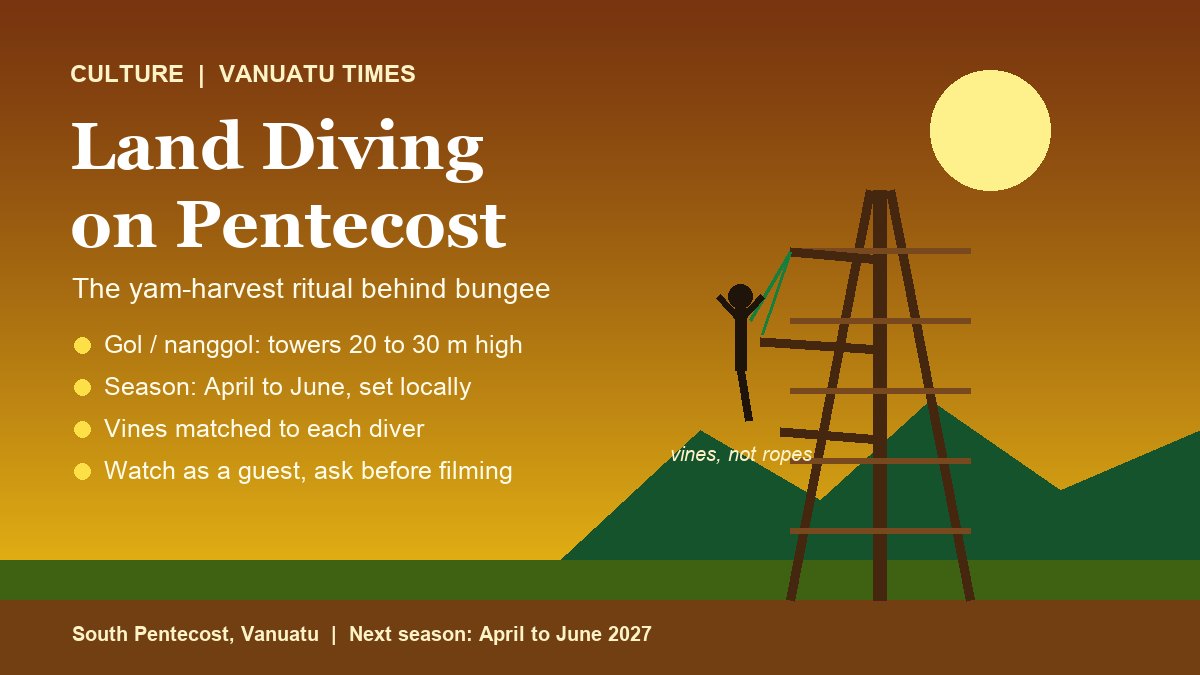
Short answer: land diving is a men's ritual on the south of Pentecost Island in Vanuatu. Divers leap head-first from hand-built wooden towers roughly 20 to 30 metres high with a vine tied to each ankle, and the vines stop them just before they hit the soil. It is called gol in the Sa language and nanggol in Bislama, it is linked to the yam harvest, and it is held between April and June. It is the ritual that is widely credited as the inspiration for modern bungee jumping, but it is a cultural event first and a tourist attraction second. The 2026 season has finished, so if you want to watch one, the next one to plan for is April to June 2027.
What land diving actually is
Pentecost is one of Vanuatu's 83 islands, about 190 kilometres due north of Port Vila, and it is mountainous, green and wet. In the south of the island, villages build a tower each year and the men jump from it. Unlike a bungee jump, the vine does not hold the diver in the air. The aim is to fall as far as possible and to brush the shoulders against the ground, so the ground is dug over and softened first, and the vine is cut to the diver's weight so that it tightens at the last moment.
According to Guinness World Records, the g-force at the lowest point of a dive is the greatest experienced by humans in the non-industrialised world. Divers cross their arms over their chest and tuck their heads in, and the risks are real: a broken neck or a concussion are possible if the vine is wrong.
Why they do it: yams, courage and manhood
Three ideas run together in the tradition.
- The yam harvest. The dive is tied to the annual yam harvest, and the belief is that a good, high dive helps secure a bountiful crop. A successful dive is also said to take away the illnesses of the wet season and strengthen the divers.
- The origin story. A story told to David Attenborough in 1959 describes a woman who tied vines to her ankles and jumped from a banyan tree to escape her husband. He jumped after her without vines and died. In other tellings the husband is called Tamalie. The men built towers to show they would not be tricked again.
- A rite of passage. Boys start on the lowest platforms after circumcision, at around seven or eight. When a boy dives, his mother holds a favourite childhood item, often a piece of cloth, and it is thrown away afterwards to show he has become a man.
The tradition is part of kastom, the body of customs, land rules and obligations that still organises village life. Most islanders are Christian today, but they keep the older beliefs alongside.
How the tower and the vines are prepared
Preparation takes weeks and has its own rules:
- The tower. It takes roughly two to five weeks to build, with 20 to 30 men cutting freshly felled timber, lashing it together with vines and clearing the site. Several platforms jut out from the front at different heights, the lowest around 10 metres. The supports are designed to snap or hinge during the jump to absorb some of the force.
- The vines. A village elder chooses them and matches them to each jumper's weight without any mechanical calculation. They have to be supple, elastic and full of sap, so they are kept bundled in leaves until the ceremony. If the vine is too long the diver hits the ground hard; if it is too short he can strike the tower.
- The men. During the preparation the men stay apart from the women. Women are not allowed near the tower, and the divers settle unfinished disputes beforehand in case something goes wrong. The night before, divers sleep beneath the tower.
Timing matters. Tower building is easiest in the dry season and the vines are at their most elastic around the yam harvest, which is why the season is April to June. Nothing shows this better than an episode from 1974: when Queen Elizabeth II visited Vanuatu, a jump was staged for her in the middle of the wet season. The vines were not elastic enough, and one diver broke his back and later died in hospital.
What happens on the day
Before dawn the men wash, rub coconut oil on their skin and decorate their bodies. They wear traditional nambas (penis wrappers) and boar tusks. Women and girls dress in grass skirts and dance and chant at the foot of the tower; only men dive, but the singing is part of the support. Around 10 to 20 men in a village usually jump.
The order is from least to most experienced. Boys and novices go from the low platforms, and the most experienced diver goes from the top, often after a speech, a song or a mime. Right after each jump the villagers rush in to untie and check the diver. One estimate puts the speed on the way down at about 72 km/h.
From banned ritual to bungee jumping
In the mid-nineteenth century, missionaries persuaded people on the island to stop land diving. In the 1970s, as anti-colonial feeling grew, the ritual came to be seen as an expression of cultural identity, and after independence in 1980 it was revived. Our short history of independence in 1980 explains the context.
The world heard about it through film and print. David Attenborough's BBC series The People of Paradise featured the land divers of Pentecost, first broadcast on 21 April 1960. In 1970, National Geographic published journalist Kal Müller's account of the dive he joined at Bunlap after waiting two years for an invitation.
The link to bungee jumping is documented. The first modern bungee jumps took place on 1 April 1979 from the Clifton Suspension Bridge in Bristol by members of Oxford University's Dangerous Sports Club, who had been discussing the Vanuatu vine-jumping ritual. Commercial bungee jumping followed, with New Zealander A. J. Hackett making his first jump from an Auckland bridge in 1986. In 1995 the people of Pentecost, supported by Vanuatu's attorney-general, said they would try to claim royalties from bungee operators because they regarded the tradition as taken from them. The questions of cultural property are still open.
Planning a visit to see it
When. April to June, usually on set days each week during the season. Exact dates and the village that is diving are decided locally and change from year to year, so confirm them with a Port Vila tour operator or your accommodation. Do not trust a date from an old blog post, including this one. For the weather that month, see our Port Vila weather by month guide: the dry season on Pentecost runs from about May to October, and the rainy season from November to April.
Getting there. Lonorore Airport (LNE) in the south-west of Pentecost is used by Air Vanuatu for domestic flights to Port Vila and Santo, sometimes via Ambae. Schedules change often, with typically two or three flights a week, and in the season there are day trips from Port Vila to see the dive. The planes are small, so luggage limits and weather cancellations are common; build in a spare day. Our guide to flights to Vanuatu covers the international side.
Cost. One source reports that tourists typically pay 10,000 to 12,000 vatu per person to attend, though the figure is undated, so ask for the current price before you book. Take cash in small notes: see the Vanuatu money guide for ATMs and what to carry to outer islands.
Behaviour. You are a guest at a ceremony, not a show.
- Follow your guide's instructions on where to stand and stay away from the tower, which has its own rules.
- Ask before photographing individuals. Commercial filming was reportedly restricted by the Vanuatu Cultural Centre in 2006 to protect the culture, so do not set up professional filming without permission.
- Dress modestly in villages, and do not ask to jump. Visitors who ask to try it are usually turned down for safety reasons.
The chiefs set up a tourism council to handle visitors and presentation, and the idea is that local control keeps the ritual authentic while bringing in money. How well commercial demand and tradition fit together is a debate that researchers have studied; see the 2013 paper "Tourism and Traditional Culture: Land Diving in Vanuatu" in the Annals of Tourism Research. For the bigger picture of travel income, read our piece on Vanuatu tourism after COVID.
Frequently asked questions
Is land diving the same as bungee jumping?
No. A bungee cord stretches and bounces you back up. Land-diving vines are not meant to stretch much; they simply stop the fall near the ground, and the diver intentionally almost touches the soil. The ritual is the inspiration for the sport, not a version of it.
When is the land diving season in Vanuatu?
April to June, during the yam harvest. Once a single annual event, it is now held weekly in the season because of tourism. Confirm each year's dates locally.
Can tourists land dive?
Generally no. Outsiders who ask are often refused for safety reasons, and the ritual belongs to the men of the villages. A few outsiders have been invited, such as journalist Kal Müller in 1970, but that was after long stays.
Do women take part?
Only men dive. Women and girls dance and sing at the base of the tower, and in the origin story it was a woman who first jumped with vines.
Is it dangerous?
Yes. Divers can suffer broken necks, concussion and other injuries, and a death was reported after the 1974 jump staged out of season. Villagers choose vines, timing and ground conditions carefully to lower the risk, but it can never be removed. See also our Vanuatu safety guide for general travel safety.
Where is Pentecost Island?
About 190 kilometres north of Port Vila, in Penama Province. It covers around 490 square kilometres and had 16,843 people at the 2009 census. Land diving takes place in the south of the island.
Sources
- Land diving: ritual, preparation, history and tourism (with cited sources including HowStuffWorks, ABC News, National Geographic and Attenborough)
- Pentecost Island: location, area, population, seasons and land diving
- Lonorore Airport: Air Vanuatu services and seasonal day trips
- Bungee jumping: origins in the Pentecost ritual, 1979 Clifton jump, A. J. Hackett
- BBC: The People of Paradise, The Land Divers of Pentecost (first broadcast 21 April 1960)
- Cheer, Reeves and Laing (2013), Tourism and Traditional Culture: Land Diving in Vanuatu, Annals of Tourism Research