Travel
Port Vila Airport Guide: Arrival, Biosecurity and Transport
A step-by-step guide to Port Vila International Airport: immigration, biosecurity rules, customs, ATMs and exchange, taxi fares, car hire and transfers, from the airport operator's own passenger pages.
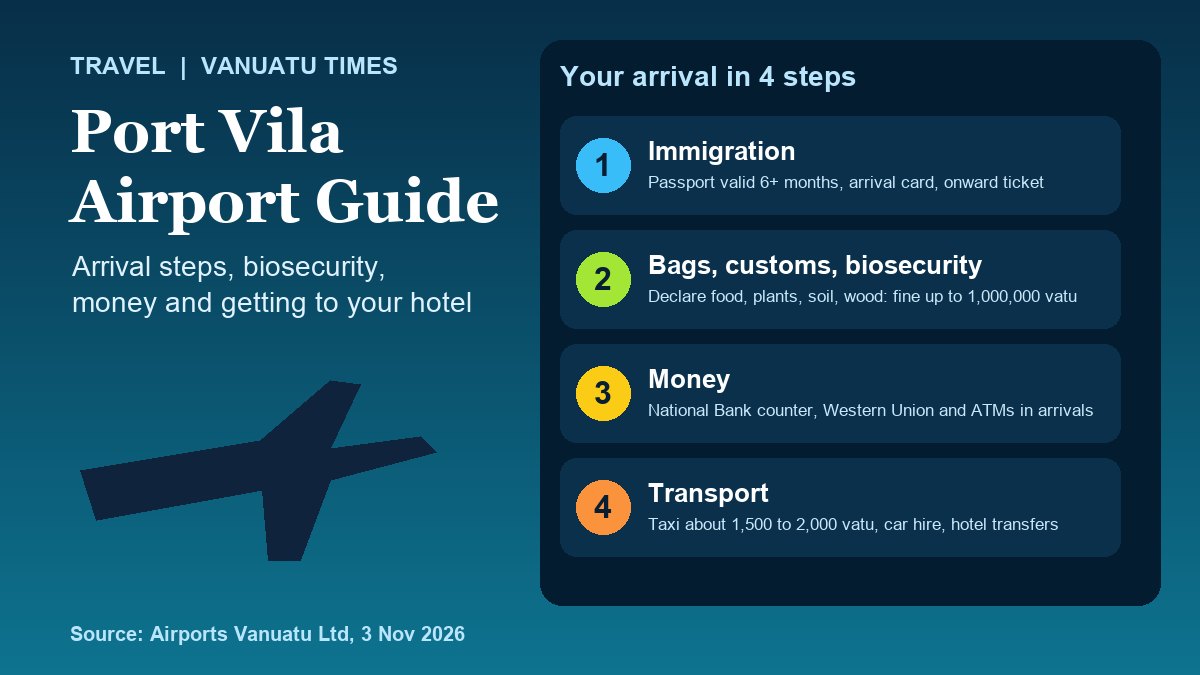
Short answer: Port Vila International Airport (code VLI, still called Bauerfield by many locals and older guidebooks) is a compact terminal on the south-west coast of Efate, a short drive from the capital. Arrival follows a fixed order: immigration, baggage, customs and biosecurity, then the arrivals hall, where you will find a bank counter, ATMs, car-hire desks, tour and hotel transfer desks and a taxi rank. Hotels are mostly 5 to 15 minutes away, and the airport's own guide puts a taxi to a hotel at about 1,500 to 2,000 vatu.
This guide walks through the airport in the order you will meet it, using the passenger pages published by the operator, Airports Vanuatu Limited (AVL). It is a practical companion to our guide to who flies to Vanuatu, and it covers the first-hour questions about forms, cash and rides.
What kind of airport is it?
Port Vila is Vanuatu's main gateway. AVL describes it as the airport that handles most of the country's international and domestic passengers, with onward domestic flights to islands across the archipelago and air freight for tourism and trade. AVL owns and runs three airports, Port Vila, Santo and Tanna, and the government is the sole shareholder.
The airfield began as a US military strip in 1942, when Marines and Seabees cleared a runway on Efate for the Pacific war. It is the country's oldest major airfield, and the runway was rebuilt in a World Bank funded project that RNZ reported reopening in 2019. The strip is about 2,600 metres long, long enough for wide-body jets, though regular services today use smaller aircraft.
Facilities are modest by big-airport standards. The AVL facilities page lists duty-free shops, cafes and food outlets, and the transport options below. Do not expect a large retail concourse, and keep some cash handy.
Step 1: Immigration
On arrival you pass through immigration first. AVL's border-control page says travellers should have:
- a passport valid for at least six months,
- a completed arrival card (handed out on your inbound flight), and
- onward or return travel details ready to show.
AVL notes that many nationalities receive a visitor visa on arrival for a short tourist stay. Rules differ by passport and can change, so check your own nationality with the Vanuatu Department of Immigration before you fly, not at the desk. The airport's published immigration phone line is +678 22354 for passengers who need to ask.
Step 2: Baggage, customs and biosecurity
After immigration you collect your bags and go through customs and biosecurity before leaving the terminal. This is the step that catches people out, because Vanuatu protects its farming and wildlife strictly.
The arrival card is a legal document. AVL says it lists the regulated goods you must declare, including food, plant and animal products, and outdoor or sporting equipment. Anything regulated must be declared or put in the amnesty bins at the international airport. If you are unsure whether something counts, declare it and let an officer decide.
The airport's passenger guide says you cannot bring in, without an import permit and quarantine inspection:
- live plants, seedlings, roots, leaves, flowers and seeds of any kind,
- fruit and vegetables,
- soil, or anything with soil on it (check hiking boots and camping gear), and
- wood or bamboo, and animals or animal products.
The same page says that failing to declare goods that are then found can carry a fine of up to 1,000,000 vatu. For the full rules, use the Vanuatu Biosecurity website. Customs declarations are also needed for goods carried for business or on behalf of other people, restricted items such as medicines or firearms, and cash of 1,000,000 vatu or more (or the foreign-currency equivalent).
Duty-free allowances for adults, as listed by AVL, include 2.25 litres of spirits, 2.25 litres of wine and 9 litres of beer, plus 250 cigarettes or 250 grams of tobacco. Quote these only as a guide and confirm with customs if you are near a limit.
Step 3: Money in the arrivals hall
The local currency is the vatu (VUV). At the airport:
- National Bank of Vanuatu runs the branch in the arrivals commercial corridor, with currency exchange and banking during airport operating hours. AVL says it is currently the only bank branch in the arrival area.
- Western Union has a counter in the arrivals area for exchanging and sending money.
- ATMs are in the international terminal after baggage reclaim, outside near the taxi area, and at the domestic terminal.
Take a little vatu out before you leave the building, because small taxis and minibuses may not take cards. Our Vanuatu money guide covers cards, tipping and cash habits in more detail.
Step 4: Getting to your hotel
AVL's transport page lists four ways to leave the terminal:
- Taxi. Taxis are privately owned and approved by AVL, wait at ranks outside arrivals and carry taxi signs and airport branding. AVL's guide puts the fare to a resort or hotel at roughly 1,500 to 2,000 vatu. Agree the price before you set off if the car has no meter.
- Hotel and tour transfers. Operators with desks in the arrivals lounge include Malakase, Adventure in Paradise, Bountiful Tours and Transfers, Atmosphere, Ramada and The Havannah. Book ahead through your hotel if you arrive late.
- Car hire. AVL lists Hertz, Avis, Budget, Europcar, Global Car and World Car Rental, with desks in arrivals. You will need a valid driving licence and a credit card, and booking early is wise in peak season.
- Buses and shared minibuses. These run on the main routes around town and the resort areas, and you pay the driver directly. They are the cheapest option but are not always easy with large bags.
Transit hotels sit close to the terminal. AVL says one is walkable or a very short taxi ride away, and other hotels are 4 to 5 kilometres, about 5 to 15 minutes, from the airport. That makes a night near the airport a sensible buffer if you have an onward domestic flight the next morning.
Departing: what to plan for
- Security screening. Carry-on bags are X-rayed, laptops or metal items may need to come out, and liquids are limited to 100 ml each in a clear 1-litre bag.
- Departure tax. AVL's guide mentions a passenger departure tax but the wording on whether it is already in your ticket is unclear. Ask your airline when you book so you are not caught short at the counter.
- Domestic connections. Domestic flights leave from the domestic terminal, which has its own ATMs. Leave generous buffers, because small aircraft schedules and weather change often. If you plan a trip to Tanna, our Tanna island guide explains what to expect, and the Espiritu Santo guide covers the other main flight route.
Santo and Tanna airports in brief
Santo (Pekoa) is the second-busiest airport and the entry point for Luganville and the north. AVL says it handles domestic and international traffic and that facilities are simple but better than the smaller regional airports. Tanna's airport, near Whitegrass, is a small domestic airport with basic facilities, no duty-free, and transfers usually pre-arranged with your resort or by taxi or minibus. Carry cash and allow extra time for weather delays.
Useful numbers from the airport guide
- Airports Vanuatu head office: +678 25111 (weekdays)
- Immigration: +678 22354
- Biosecurity (quarantine): +678 23519
- Customs: +678 22566 or +678 23593
- Border police: +678 111 or +678 28757
Numbers and opening details come from the operator's pages as checked on 3 November 2026 and may change. If your arrival coincides with bad weather, our Port Vila weather guide explains the wet and cyclone season, and our Port Vila city guide helps you plan the first day in town.
Frequently asked questions
Is Bauerfield the same as Port Vila airport?
Yes. Bauerfield is the old name, and AVL now brands the airport as Port Vila International Airport. The airport code is VLI.
How far is the airport from Port Vila town?
It is a short drive. AVL says the nearest resorts are about 4 to 5 kilometres away, around 5 to 15 minutes by road.
Can I bring fruit or snacks into Vanuatu?
Not fresh fruit, vegetables or seeds without a permit and quarantine inspection. Declare any food on your arrival card, or use the amnesty bins before you reach the biosecurity officers.
Is there an ATM at the airport?
Yes. AVL lists ATMs at the international arrivals area, outside near the taxi ranks and at the domestic terminal, plus a National Bank of Vanuatu branch for exchange.
Do I need a visa for Vanuatu?
Many nationalities get a visitor visa on arrival for a short tourist stay, according to AVL, but it depends on your passport. Check the Department of Immigration before you travel.
Sources
- Airports Vanuatu Limited: Passenger Guide, Border Control, Transportation, Airport Facilities and Our History (checked 3 November 2026)
- Port Vila International Airport (Wikipedia, runway length, wartime origin and renaming)
- RNZ: Vanuatu airport runway reopens after refurbishment