Environment
Vanuatu Cyclone Season 2026-27: Colour Alerts, Categories and What to Do
What Vanuatu's Blue, Yellow and Red cyclone alerts mean, how categories 1 to 5 differ, what the 2026-27 outlooks say, and what residents and visitors should do at each step, from NDMO and VMGD sources.
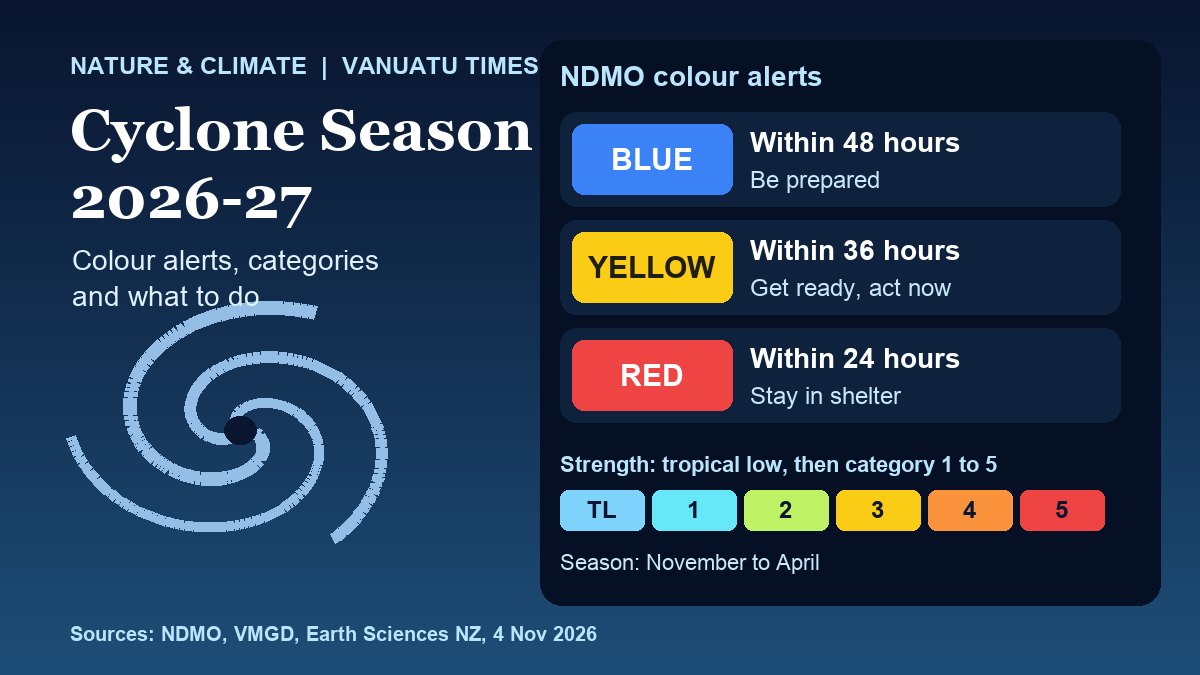
Short answer: Vanuatu's cyclone season runs from November to April, and the country uses its own three-colour alert system on top of the usual 1 to 5 cyclone categories. A Blue Alert means a cyclone is forecast within 48 hours (be prepared), a Yellow Alert means within 36 hours (get ready and act now), and a Red Alert means within 24 hours (stay in a shelter or safe place). The National Disaster Management Office (NDMO) later calls the All Clear once the Vanuatu Meteorology and Geo-Hazards Department (VMGD) cancels the warning for your area.
The new season is starting under unusual conditions. A strong El Niño is under way across the Pacific, and regional forecasters expect normal to above-normal cyclone activity. This guide explains what the alerts and categories mean, what the 2026-27 outlooks actually say (and what they do not), and what residents and visitors should do at each step. It complements our Port Vila weather by month guide and our explainer on the volcano alert levels, which work on a different scale.
When is Vanuatu's cyclone season?
NDMO says Vanuatu is regularly subject to cyclones between November and April each year. VMGD publishes a Tropical Cyclone Warning every day of the season at 6am and 6pm, and the National Disaster Management Office turns those forecasts into community alerts. Storms can form outside the official months: the Southwest Pacific outlook notes that cyclones sometimes occur out of season, and extended forecasts this year hinted at an early start.
Cyclones are not the only seasonal hazard. Heavy rain, flooding, rough seas and landslides can arrive with tropical lows and storms that never reach cyclone strength. That is why the lowest step on the scale below is a tropical low, not a cyclone.
What the 2026-27 outlooks say
Two forecasts matter, and they measure different areas.
- Whole Southwest Pacific. Earth Sciences New Zealand (the former NIWA), working with MetService, the University of Newcastle and Pacific meteorological services, published its outlook on 14 October 2026. It expects seven to eleven named cyclones across the Southwest Pacific from November 2026 to April 2027, against a 1991-2020 average of around nine. It says at least four severe cyclones (category 3 or higher) may occur somewhere in the region.
- Vanuatu. The Vanuatu Daily Post reported on 30 October that Vanuatu is forecast to experience three to five tropical cyclones this season, with two to three potentially reaching severe strength. Treat the national forecast from VMGD as the one to follow for Vanuatu itself.
The regional outlook also explains why a strong El Niño matters. In past El Niño years the region has seen more cyclones overall, with activity shifting towards the area near and east of the International Date Line, while the risk for the western part of the basin is described as normal to reduced. That is a statement about seasonal odds, not about any single storm. The outlook itself stresses that it does not take a direct hit or a severe cyclone to cause damage, so everyone should stay prepared.
A forecast of "three to five cyclones" does not mean three to five cyclones will hit your island. Most storms pass at a distance, and the colour alerts are what tell you whether your area is at risk.
The three colour alerts, explained
NDMO's colour alerts are issued by VMGD forecasts and are tied to provinces, so one island group can be on Red while another is on Yellow. During Cyclone Harold in April 2020, for example, the Australian High Commission relayed that a Red Alert was in place for Torba, Sanma, Penama and Malampa, and a Yellow Alert for Shefa. Always check the alert for your own province.
Blue Alert: be prepared (forecast within 48 hours)
This is the early warning. NDMO's checklist for a Blue Alert includes:
- stay tuned to radio, TV, SMS or the internet,
- secure or stow loose material and rubbish, tie down roofs and prepare cyclone shutters,
- put valuables and important documents in waterproof containers or bags,
- cut down dangerous trees and branches, and trim bananas and cassava,
- prepare water, food, lamps, torches and matches, charge your phone and keep spare radio batteries,
- identify the strongest area of the house and the nearest evacuation centre, and work out how long it takes to reach it, and
- make a plan for animals and support vulnerable family and neighbours.
Yellow Alert: get ready, act now (forecast within 36 hours)
The checklist now shifts from preparing to acting. NDMO asks people to finish every Blue Alert task urgently and to:
- bring together the people you are responsible for, including children from school,
- put fuel in vehicles and park them safely, and move boats to safe storage,
- install cyclone shutters and tape windows and louvres,
- keep animals in safe areas, and
- move early to an evacuation centre or safe place if your house or area is unsafe.
Red Alert: stay in shelter (forecast within 24 hours)
At Red you should already be where you will ride the storm out. NDMO says to stay in the strongest and safest part of the house or in the evacuation centre, away from doors and windows, turn off gas and electricity and unplug appliances, and not go outside until NDMO issues the All Clear. Even after the winds drop, take care around fallen power lines, trees and damaged buildings.
One honest caveat: NDMO's alert page and VMGD's 2020 tracking map both give the headline forecast windows as 48, 36 and 24 hours, but the detailed text on each page quotes slightly different times for when gale-force winds begin. Do not wait for a deadline. The moment your province is on Blue, start preparing.
Cyclone categories: what 1 to 5 mean on the ground
The colour alerts say how soon, and the category says how strong. VMGD and NDMO use six steps. Any storm at category 3 or above counts as a severe tropical cyclone; Earth Sciences New Zealand defines that as mean 10-minute winds of at least 119 km/h.
- Tropical low (strong winds): negligible damage to old thatch houses and some garden crops such as bananas; whistling in power lines.
- Category 1 (gale force): twigs break off trees, slight structural damage, roofing dislodged, garden crop damage.
- Category 2 (storm force): considerable structural damage, trees uprooted, heavy crop damage, risk of power failure.
- Category 3 (destructive): some roof and structural damage, some local thatch houses destroyed, power failures likely.
- Category 4 (very destructive): significant roofing loss and structural damage, many thatch houses blown away, dangerous airborne debris, widespread power failure.
- Category 5 (catastrophic): extremely dangerous, with widespread destruction. Sustained winds of 200 km/h or more are typical of this strength.
The two scales are independent. A slow category 1 can bring days of flooding, and a category 4 far offshore may only mean big swells. This is why a single "category" headline in the news tells you little about whether to shelter. Check the alert for your province and the track.
How to follow warnings in real time
- VMGD publishes the Tropical Cyclone Warning at 6am and 6pm each day of the season, and a cyclone tracking map you can print. See the VMGD website.
- NDMO issues the colour alerts and the All Clear, and publishes cyclone awareness guidance, including radio stations that broadcast updates. NDMO phone numbers on its site are +678 22699 and +678 33366.
- Radio, TV and SMS are the main channels in the outer islands where mobile data is patchy. Keep spare batteries for a handheld radio.
- Beware of fake sites. NDMO warns that official Vanuatu government sites end in .gov.vu.
If you are visiting Vanuatu in cyclone season
Travel during the season is common and most days are fine, but plan with the odds in mind. Our flights to Vanuatu guide covers the carriers, and these steps reduce the risk of being caught out.
- Check that your travel insurance covers named storms, cancellations and evacuation, and read the exclusions before you buy.
- Choose refundable or changeable bookings for inter-island flights and ferries; services stop early when a warning is issued.
- Ask your hotel on arrival what its cyclone plan is and where its shelter is. Keep some vatu cash, because ATMs and card terminals fail during power cuts (see our Vanuatu money guide).
- Follow the same colour-alert actions as residents, and follow the instructions of your hotel and local authorities.
- Keep passports, medication and phone chargers in a waterproof bag you can grab quickly.
For everyday risk beyond storms, including earthquakes and health, see how safe is Port Vila. For the longer story of what a severe cyclone does to a country, read our piece on Cyclone Harold and the reconstruction and the wider Pacific climate change context.
Frequently asked questions
What are the cyclone alert colours in Vanuatu?
Blue (cyclone forecast within 48 hours, be prepared), Yellow (within 36 hours, get ready and act now) and Red (within 24 hours, stay in shelter). NDMO issues them by province and calls an All Clear once VMGD cancels the warning.
When does cyclone season start in Vanuatu?
Officially in November and it lasts until April, according to NDMO. Storms can occasionally form outside those months.
How many cyclones are expected in 2026-27?
The regional outlook expects seven to eleven named cyclones in the Southwest Pacific, with at least four severe. The Vanuatu Daily Post reported a national forecast of three to five cyclones, two to three potentially severe. Forecasts describe seasonal odds, not individual storms.
What is the difference between a cyclone category and an alert?
The category (tropical low, then 1 to 5) is the storm's strength. The colour alert is how soon it is forecast to affect your province and what action to take. You need both pieces of information.
Is it safe to travel to Vanuatu in cyclone season?
Most days are normal, and many people visit between November and April. Take insurance that covers storms, keep flexible plans, follow VMGD and NDMO advice, and follow your hotel's instructions if a Blue Alert is declared.
Sources
- Vanuatu National Disaster Management Office: Cyclone awareness, Colour alerts and Cyclone categories (checked 4 November 2026)
- VMGD: Vanuatu Cyclone Tracking Map (revised October 2020)
- Earth Sciences New Zealand: Southwest Pacific Tropical Cyclone Outlook, October 2026 and the 14 October media release
- Vanuatu Daily Post, cyclone season forecast 2026-27 (30 October 2026)